

 Socious Report
 Socious Work
 Socious Verify
The UK Adopted the ISSB Standards, Then Took the Dates Out of Them
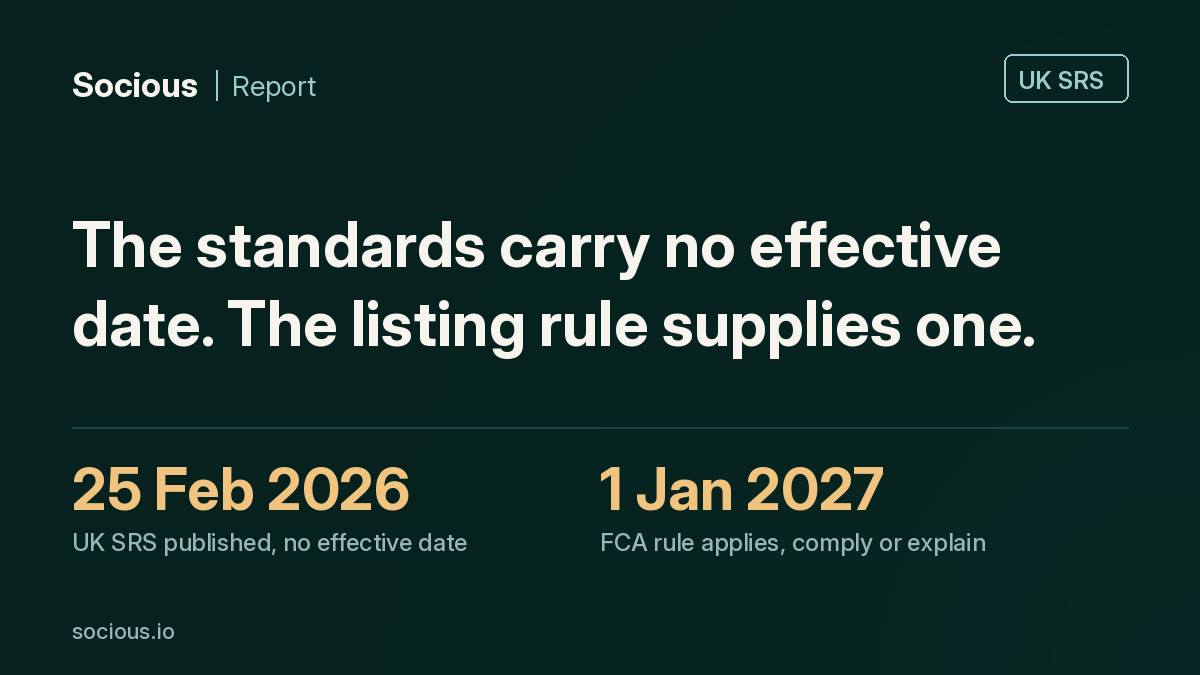
On 25 February 2026 the Department for Business and Trade published the United Kingdom’s own version of the ISSB standards. UK SRS S1 covers general requirements for disclosure of sustainability-related financial information. UK SRS S2 covers climate-related disclosures. Both were issued for voluntary use by any entity.
Neither carries an effective date. The government took it out before publication and said the effective date would be set in future legislation. The time limits on the transitional reliefs came out as well, left for UK regulators to set when mandatory requirements arrived.
A company reading the standards in March 2026 could therefore find the full text of what to disclose and nothing at all about when.
The standards bind nobody by their own force
This is a real difference from how the ISSB standards work elsewhere. IFRS S1 and S2 as issued carry an effective date, and a jurisdiction adopting them usually brings that date across or substitutes its own. The UK kept the content and left the timing blank.
The UK also made its own amendments to the text. References to the SASB Standards, which IFRS S1 requires an entity to consider when identifying sustainability risks and opportunities, are optional under UK SRS. That matters for anyone who has been working through the 2026 amendments to the SASB industry metrics, because the UK is the one major adopter that does not oblige you to use them.
The government described these as amendments made to tailor the ISSB standards for the UK context. They are the reason UK SRS and IFRS S1 and S2 are not word-for-word identical.
So UK SRS on its own is a reporting framework a company may choose, and the obligation comes from somewhere else.
The FCA supplied the date on 30 September 2026
That somewhere else is the Financial Conduct Authority. Its policy statement PS26/19, Aligning listed issuers’ sustainability disclosures with international standards, was published on 30 September 2026 and last updated on 13 October 2026.
The rules apply to accounting periods beginning on or after 1 January 2027. The first reports appear in 2028.
Four categories of listed issuer are in scope: the commercial companies category, the transition category, the non-equity shares or non-voting equity shares category, and the secondary listing or depositary receipts category. The rules replace the existing climate-reporting requirements for listed issuers, which were introduced in 2021 and aligned with the Task Force on Climate-related Financial Disclosures.
For a listed issuer, the practical sequence is that UK SRS has been available since February 2026, becomes the basis of a listing-rule obligation for years starting in January 2027, and produces its first reports in 2028.
Comply or explain runs across the whole framework
The FCA had consulted on applying comply or explain to the non-climate disclosures under UK SRS S1, while proposing that climate disclosures under UK SRS S2 be mandatory.
The final rules apply comply or explain across all categories of disclosures. That brings S2 into line with the approach consulted on for S1. The FCA’s stated reasoning is that this balances investor needs with market readiness and the maturity of reporting practices.
An issuer in scope must therefore either publish a climate disclosure that meets UK SRS S2, or explain why it has not.
The reliefs came back as regulator rules
The transitional reliefs whose time limits were stripped out of the standards reappear in the FCA’s rules with lengths attached.
Scope 3 emissions disclosures have one year of transitional relief. The wider sustainability disclosures under UK SRS S1 have two years.
Read with the start date, that gives a first in-scope year beginning 1 January 2027 in which an issuer can defer Scope 3, and a first two years in which it can defer the non-climate content of S1. The ISSB’s own year-two transition reliefs cover the same two areas.
An explanation is a disclosure
Comply or explain is often read as the soft option. It removes the legal requirement to produce the numbers. It does not remove the requirement to say something.
An issuer that does not comply has to explain, in a document investors read, why its climate disclosure does not meet the standard the regulator has named. That explanation is a public statement about the maturity of the company’s own data and controls, published alongside its financial statements, in the same year its competitors are publishing theirs.
The FCA has also consulted separately, through Primary Market Bulletin 66, on Technical Note TN 803.1, which sets out its expectations on the level of detail issuers should provide in their UK SRS disclosures. Feedback on it is due by 28 October 2026. Companies planning to explain rather than comply should expect those expectations to be specific, and anyone who wants to shape them has about a week left to say so.
The UK’s floor does not set your group’s floor
For a group, the question is what the UK requires relative to everything else the group files.
CSRD in the European Union, SSBJ in Japan and AASB S2 in Australia are not comply-or-explain regimes. Where they apply, they apply. A group listed in London with EU operations, a Japanese subsidiary above the SSBJ threshold, or an Australian entity caught by the NGER registration route is already collecting climate data to a mandatory standard somewhere.
Once that data exists, choosing comply or explain in the UK saves very little. The expensive part of climate reporting is the dataset, not the document, and the dataset is being built to satisfy the strictest regime the group touches. Explaining non-compliance in a UK listing document while filing a full climate statement in another jurisdiction is a position that is hard to hold for long, and investors can see both.
For a group with no mandatory obligation anywhere else, the calculation is different, and the two-year S1 relief plus comply or explain is genuinely the lightest ISSB-aligned path currently available in a major market. If you are still mapping which obligations reach you, our CSRD overview sets out the European side of the same dataset.
What to do before the 2027 year starts
Four questions are worth answering now, while the first in-scope year has not begun.
Which of your listed entities sit in one of the four categories in scope, and which of your group’s reporting entities do not?
Does your accounting period start on or after 1 January 2027, and if your year end is not December, which year is actually your first?
For Scope 3 and for the wider S1 content, are you planning to use the one-year and two-year reliefs, and does that decision match what you are already doing for CSRD, SSBJ or AASB S2?
If you intend to explain rather than comply on any part of UK SRS S2, what does that explanation say about your data, and who else will read it?
Socious Report takes one dataset and drafts CSRD, SSBJ and ISSB reports from it, with an independent Socious Verify credential on the result. UK SRS is the ISSB standards with UK amendments, so the same climate dataset answers a UK listing disclosure and a European or Japanese filing. If you want to see where your data stands, start with our ISSB reporting overview.