

 Socious Report
 Socious Work
 Socious Verify
Brazil Revoked Its ISSB Mandate and Left the Assurance Requirement Standing
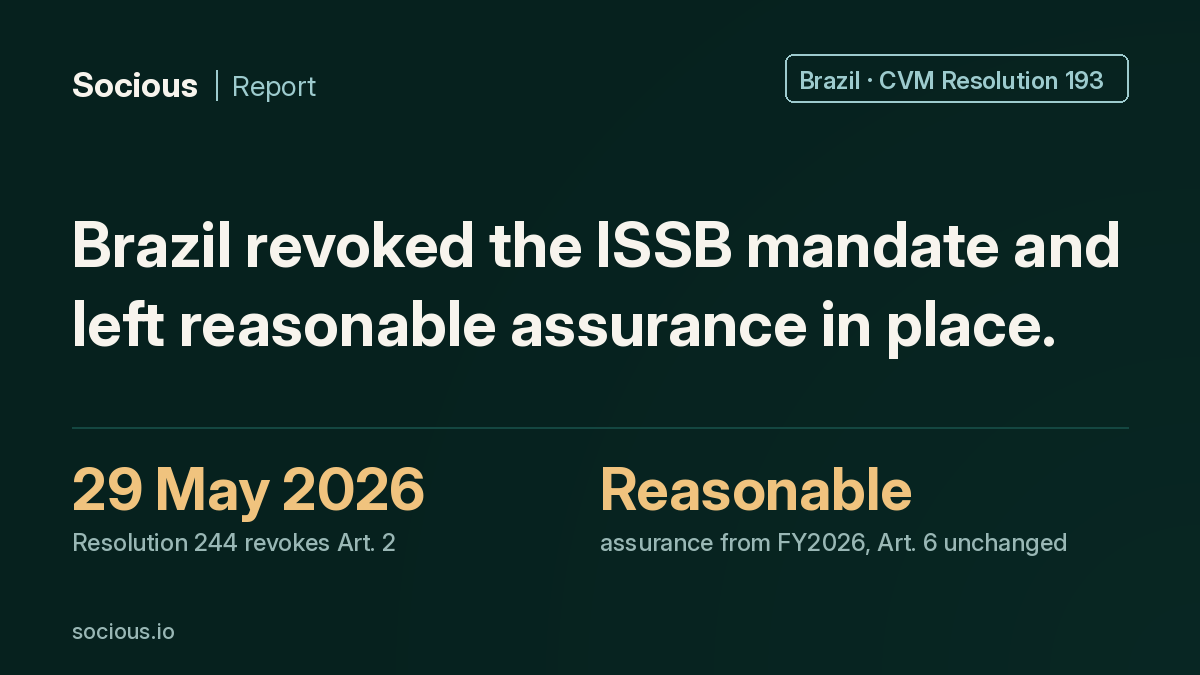
Brazil was supposed to be the proof that ISSB adoption could be mandatory.
In October 2023 its securities regulator, the Comissão de Valores Mobiliários, issued Resolution CVM 193. Article 1 opened a voluntary route for publicly held companies, investment funds and securitisation companies to report on the ISSB basis from financial years beginning on or after 1 January 2024. Article 2 then said that for publicly held companies the report would be mandatory from financial years beginning on or after 1 January 2026. That article has since been revoked.
Resolution CVM 244 revoked the mandate on 29 May 2026
Resolution CVM 244, dated 29 May 2026, is short. Its Article 1 revokes Article 2 of Resolution 193 and item III of Article 5. Its final article states that it enters into force on publication and applies to financial years beginning from 1 January 2026.
A company with a calendar financial year was five months into the period it believed it was required to report on when the requirement was withdrawn.
Two earlier resolutions had already worked on Article 2 without removing it. Resolution 227 of 31 March 2025 rewrote it to point at standards issued by the Brazilian Sustainability Pronouncements Committee and approved by the CVM, rather than at the ISSB’s English-language standards directly. Resolution 219 of 29 October 2024 had reworked the filing deadlines. Resolution 244 ended the obligation itself.
Article 6 was not touched
Resolution 193 has an assurance article, and it survived all three amendments unchanged. Nothing in Resolution 244 amends or revokes it.
Article 6 requires the sustainability-related financial report to be assured by an independent auditor registered with the CVM, in accordance with standards issued by the Federal Accounting Council. It then sets two levels. Item I: until the end of financial year 2025, limited assurance. Item II: from financial years beginning on or after 1 January 2026, reasonable assurance.
The only report the resolution still governs is the voluntary one under Article 1, because Article 2 is gone and Article 5 was rewritten to speak of “entidades optantes”, opting entities. Article 6 applies to that report, so a company filing for a financial year beginning in 2026 owes reasonable assurance, on our reading of the consolidated articles rather than on any separate CVM statement. Put it to your auditor in writing before you decide.
Article 1 names publicly held companies, investment funds and securitisation companies. Filing is optional for all of them, and the assurance level is not.
Volunteering now carries a three-year commitment
Resolution 244 also added conditions to the voluntary route that were not there before.
Article 1 paragraph 4 now says an entity that opts to prepare and disclose sustainability-related financial information must publish it for at least three consecutive financial years. Paragraph 5 says an opting entity that decides to stop publishing must announce that decision by a market communication, released by the date it files the annual financial statements for the year before the one in which it will not publish.
Article 3 requires the entity to declare explicit and unreserved adherence to the CBPS and ISSB standards. Article 3 of Resolution 244 adds that a listed company choosing to file must do so under Article 1 of Resolution 193, which closes the door on filing something ISSB-shaped without accepting the regime.
Filing deadlines under the rewritten Article 5 are: in the first financial year of filing, the same date as the Reference Form; from the second financial year of filing, within three months of the financial year end or on the same date as the financial statements, whichever comes first.
An entity that opts in commits to three consecutive years of publication. On top of that it owes reasonable assurance, and it has to announce its exit when it leaves. Opting in at all remains a choice.
From 1 January 2027, not reporting requires a public explanation
The parágrafo único added to Article 3 says that from 1 January 2027, a publicly held company that opts not to file a sustainability report must justify that choice by a market communication, released by the date it files its annual financial statements, describing management’s reasons.
Brazil moved the regime from mandatory to comply-or-explain, and set the explanation obligation to start a year after the mandate would have.
What a company owes, then, depends on which year you are looking at. For a financial year beginning in 2026: no obligation to report, and no obligation to explain. From 1 January 2027: still no obligation to report, and an obligation to publish management’s reasons if you do not.
An explanation published alongside the annual financial statements is a document investors and proxy advisers will read next to the accounts, and writing one well takes longer than most boards expect. A company that intends to stay out should be drafting its reasons now rather than in the filing week.
Brazil kept reasonable assurance and dropped the mandate
Other regimes softened during 2026 too. The European Union kept CSRD assurance at limited rather than escalating it, which we covered in what the Omnibus did to CSRD assurance. For the United Kingdom, the story was the effective dates being taken out of standards it had just adopted, covered in the UK’s comply-or-explain route. What is unusual in Brazil is the direction of the mismatch. The obligation went and the assurance level stayed at the top.
The obligation and the assurance level are separate levers, and in Brazil they moved in opposite directions. A reporting team that tracks only “is it mandatory yet” will read Brazil as a relaxation and be wrong about the cost of filing.
What to do about it
If you have a Brazilian listed subsidiary or are a publicly held company in Brazil, four questions settle your position.
Did you already opt in under Article 1 for 2024 or 2025? If so, the three-consecutive-years rule and the exit-notice rule now apply to that choice, and leaving is a disclosure event rather than a decision you can take quietly.
If you intend to file for a financial year beginning in 2026, have you confirmed with a CVM-registered auditor that reasonable assurance is what Article 6 now asks of a voluntary filer? Reasonable assurance costs materially more than limited and takes longer, because the auditor has to test controls rather than perform enquiry and analytical procedures. For context on what that evidence trail looks like in practice, see assurance under ISSA 5000.
If you intend not to file, who is drafting the management justification that becomes due from 1 January 2027?
And if your group already reports under CSRD or is preparing for SSBJ, how much of the Brazilian submission is the same underlying data? Usually most of it. The governance, strategy, risk management and metrics structure of IFRS S1 and S2 is the same structure the Brazilian regime adopts, which means the marginal work is mapping and assurance evidence rather than a second data collection.
Socious Report drafts audit-ready CSRD, SSBJ and ISSB reports from one dataset, and attaches an independent Socious Verify credential to the result. Because Brazil’s regime is the ISSB standards as internalised by the CBPS, the same climate and sustainability data that supports a Tokyo or European filing supports a Brazilian one. If you want to see where your own data stands, start with the ISSB readiness overview.